Free Hungary Precursor 1956
Oppression from 1945-1956 Hungarians Seeking Justice

For 1956 Hungarians, who had lived under that same oppressive system, these words validated their own pain. It wasn’t abstract politics — it was proof of unforgivable betrayal.
- Connected personal grief to collective suffering,
- That blend of faith and outrage was exactly what motivated many participants in 1956 — especially students, ex-soldiers, and families of political prisoners.
- ÁVO Stalinist secret police terror no longer to be tolerated
- My father vitez Andras Kovacs learnt everything he could between 1945-1956 to seek justice
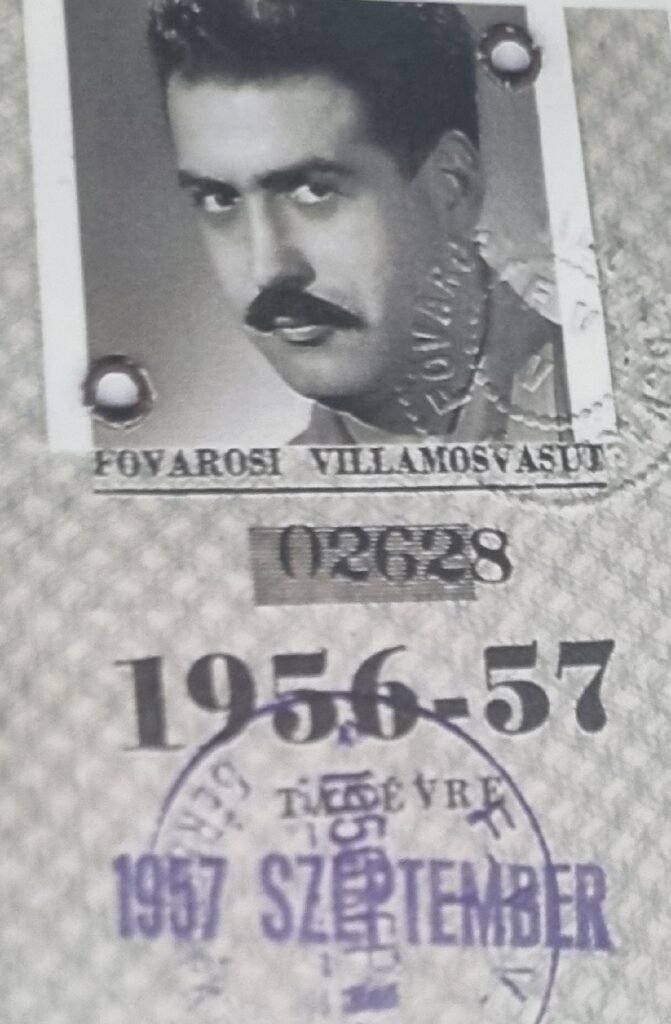

Diary
My name: András Vitéz Kovács (my mother’s name is the late Etelka Lini, my father’s name is the late Endre Vitéz Kovács, first lieutenant, who was executed by the Rákosi family in 1949. My place of residence in 1956 was Frankel Léeó ut 10, III. 3.)
On the afternoon of October 23rd 1956, I was already there at the Bem statue and, clinging to its base, I listened to the speeches and recitations. I was an eyewitness to the time when the communist coat of arms was cut out of the Hungarian flag and the first “Lukas Flag” was born.
From there I went to recruit with several of my friends in a truck, saying “whoever is Hungarian. is going to the Parliament with us”. By the time we got to the Parliament, the news had already spread that people were being shot at the Radio (this was not true at the time). We immediately went to the Radio with several trucks of demonstrators. I stood on the top of the driver’s cab of the first truck with a Hungarian flag in my hand. We stopped directly under the balcony. Here, since I was standing closest to the communist Radio employees on the balcony, I demanded that the envoys who were already inside and were being held there be released, who demanded that the points be announced. They did not. The crowd grew, and finally patience ran out and they broke the gate with a Dodge parked in front of the gate. Then all hell broke loose. I stayed there for about until 11:30, during the shooting, we captured an ambulance that would have brought ammunition to those in the Radio, I was an eyewitness when the Hungarian armored vehicles entered Bródi Sándor Street and the ÁVH officers shot one of the crew members from the top of one of the tanks.
The next day, the afternoon of the 24th, I organised the guard at the Buda bridgehead of the Margaret Bridge. Here, in exchange for food, wine, and civilian clothes, we bought two fighting cars from the Russians, which then went with Hungarian revolutionaries towards Széna Square. Jenő Fónay, to whom I gave a pistol, later joined us here.
From then on, I was partly at the Buda bridgehead of the Margaret Bridge and partly at Széna Square until October 29, when I went to the Szabad Nép printing house with Gyuri Marton Oroszi and a few of my companions, József Dudással, who was executed when the revolution was crushed.
My work on Széna Square was mixed, I ran around a lot for weapons, including to the county barracks and the Bem József (then Pálfy Square) barracks. I was active from the very first moment. Also on Széna Square, I had a pellet gun set up on the roof of the house on the corner of Ostrom Street (the guys didn’t know how to attach the magazine).
Details of my further actions are discussed in the court minutes of Szabad Nép. According to Jenõ Fónay, with Dudás and They would have executed me together with Uncle Szabó if I had stayed at home. The data in the minutes and in the so-called White Book II. volume published by the communist government do not cover the reality in all respects, but one thing is clearly proven: I was the commander of the Free People, I spent my time not with filing documents, but with serious revolutionary activity with my comrades, the “lambs” and the “headhunters” . Gathering the ÁVH, participating in street fights, maintaining order, and preserving the purity of the revolution were our main tasks.
Around November 9th, our unit disbanded and everyone went their separate ways. I headed west because I knew that I would be in trouble, just like my late father, if I stayed home.
Escape
During my escape, I was captured first in Gyõr, and then, after I miraculously escaped from there, in Mosonmagyaróvár. I escaped from there too and crossed the Austrian border with several of my companions (“lambs”) at the village of Levél.
I emigrated from Austria to Australia and first founded the Hungarian Freedom Fighters Association in Melbourne in 1957 with a small group. We were the first and only ones to lay a wreath at the Tomb of the Unknown Soldier in Australia on the one-year anniversary of the revolution. From there I moved to Sydney in 1958, where four of my former revolutionary comrades from Melbourne accompanied me and here I founded the Hungarian Freedom Fighters Association. In addition to my wife, who was also a refugee in 1956, Feri Bene and three other freedom fighters who came with me from Melbourne, as well as a boy who joined us here, were the core of the association.
Shortly after our formation, new members joined, but internal strife arose. In order to avoid a fight, I decided to leave and not participate in the struggle for leadership. This was the reason for my leaving, and not my university studies, as the person who forced me to take this step is still claiming.
I would like to emphasize that the name of the association was the Hungarian Freedom Fighters Association and NOT 56-os Reuradalmarok Szövetsége , as it was widely disseminated here by the above person, in order to appropriate the establishment of the Hungarian Freedom Fighters’ Association for himself. Later, he changed the name to the Independent Hungarian Freedom Fighters’ Association.
After that, I taught folk songs and dances for years at the Szent István Hungarian School.
Currently the co-chairman of the Certified Hungarian Freedom Fighters Association , led by József Apró .
He was knighted in 1995.
God knows that everything happened as I wrote above.
With comradely and compatriot greetings